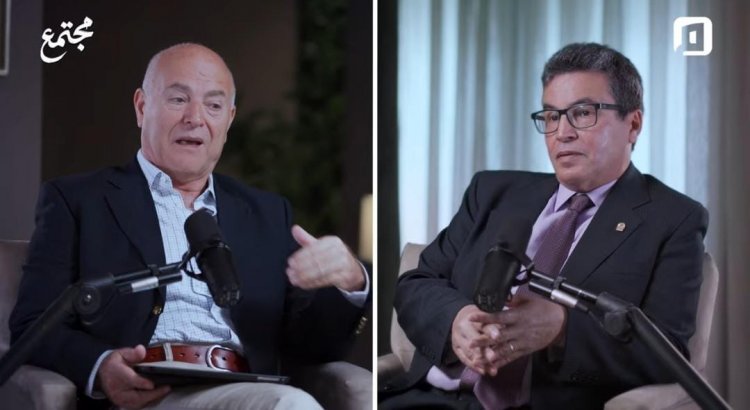
Hebrew in the Shadow of Arabic: Dr. Said Gafaiti Vision of Moroccan Identity and Linguistic Heritage
Author: Ismail RHARIB
Introduction: Morocco as a Civilizational Nexus.
Morocco transcends its geographic position at the Mediterranean’s western frontier, functioning as a radiant civilizational beacon and a vibrant human mosaic. Historically, the region has served as a convergence point for diverse currents, forging a resilient and singular synthesis of identity. Central to the Moroccan context is what may be termed the "genius of absorption"—an innate capacity to weave disparate cultural and linguistic threads into a cohesive tapestry of knowledge. This process flourishes into an elevated intellectual discourse that defines the nation’s social and intellectual soul.
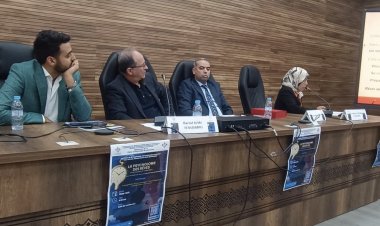
Within this landscape, Dr. Said Gafaiti offers a rigorous re-evaluation of the ties between Hebrew and Arabic. His thesis, "Hebrew in the Shadow of Arabic," posits an ontological relationship between the two, suggesting that the linguistic and cultural identity of the Moroccan persona is forged through a fundamental mirroring of these tongues.
1. The Primordial Thread: Categorizing the Jewish Presence.
To accurately analyze the Moroccan national narrative, the Jewish presence must be acknowledged as an organic, foundational component rather than an accidental imposition. This "originality" is vital to the Moroccan conscience, positioning the Jewish element as a primary thread in the social fabric. Dr. Gafaiti distinguishes between two primary groups:
The Beldi (Indigenous) Jews: Ancestral settlers who inhabited the region centuries prior to the Islamic conquests, integrating into the geography of the Maghreb long before the arrival of Arabic.
The Rumi Jews: An Andalusian elite who arrived following the fall of Islamic Iberia. These individuals arrived as purveyors of a sophisticated Andalusian epistemology, transforming Morocco into a scholarly hub.
Contemporary Moroccan identity is a synthesis of these threads: the Amazigh (the land and roots), Arabic (the universal message and lingua franca), Hebrew (spiritual and cultural intersections), and the Hassani/Sub-Saharan (the Saharan depth).
2. Philological Deconstruction:
Hebrew as an "Arubia" Dialect.
A study of Moroccan identity requires a strategic re-evaluation of linguistic terminology to decolonize historical narratives. Dr. Gafaiti challenges the traditional Western classification of "Semitic" languages—a term he critiques as an 18th-century Orientalist invention—and adopts the framework of "Arubia" (Arubia languages).
This shift frames Hebrew not as an isolated entity but as a dialect emerging from the "Mother Arabic Tongue". Gafaiti highlights a phonetic hierarchy: while the "Manifest Arabic Tongue" possesses 28 sounds, Hebrew is limited to 22. Notably, the absence of six sounds—most notably the Dad (ض)—restricted Hebrew’s capacity for complex abstraction. Historically, Hebrew utilized the Arabic "infrastructure," borrowing vowels and punctuation to evolve into a literary language.
3. The Era of Synthesis: Structural and Literary Borrowings
During the Middle Ages, Arabic functioned as a "Universal Language" and a primary cognitive vessel for sophisticated thought. This hegemony facilitated a "systematic cloning" of Arabic linguistic structures into Hebrew.
Grammatical Mapping: Abu al-Walid Marwan ibn Janah’s Al-Tanqih re-mapped Hebrew onto an Arabic skeleton, heavily indebted to the methodologies of Ibn Jinni.
Poetic Innovation: Dunash ben Labrat al-Fassi revolutionized Hebrew poetry by transposing "Khalili prosody" (the metric system of Al-Khalil ibn Ahmad) into Hebrew verse.
Judeo-Arabic: This contact birthed "Judeo-Arabic"—writing Arabic in Hebrew script—proving that while Hebrew remained a ritual tool, Arabic was the cognitive vessel for daily life.
4. Conceptual Precision: "Deen" vs. "Millah"
Dr. Gafaiti emphasizes the necessity of linguistic precision in comparative studies. He contrasts the modern academic tendency to use "Religions" (Adyan) in the plural with the Quranic perspective, which maintains "Deen" as a singular, universal truth, while categorizing specific creeds as "Millah". This distinction is an academic requirement for objectivity, ensuring a rigorous study of Judaism and Christianity within an Islamic framework.
5. The Academic Vanguard: Hebrew Studies in Morocco.
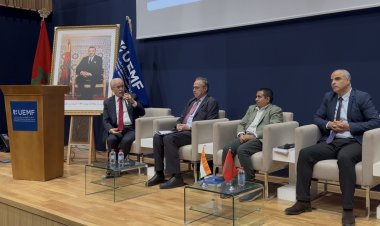
The institutionalization of Hebrew studies in Morocco is a vital act of "reclaiming history". Championed by figures such as Haim Zafrani and Dr. Ahmed Shahlan, the "Moroccan School" is unique for its emphasis on philology over politics. By requiring students of Arabic and Islamic Studies to master Hebrew as a research tool, Morocco has created a generation of scholars capable of direct engagement with original manuscripts.
6. Conclusion: The Laboratory of Coexistence.
The trajectory of Hebrew "in the shadow of Arabic" serves as the ultimate testament to the "Genius of Islamic Absorption". Just as scholars like Sibawayh codified Arabic grammar, Jewish and Christian thinkers within Islamic civilization innovated using the sophisticated tools of the Arabic language. Moroccan identity stands as a "laboratory of coexistence"—a unique space where words, creeds, and histories meet in a sanctuary of pluralism.